
“We are what we eat”
Proper 14, Year B
August 11, 2024
Stuart Higginbotham
We are what we eat
Taste and see that the Lord is good.
One of our wedding gifts was a cookbook that my grandmother, Grandy, made us. She took a journal with lined pages and hand wrote my favorite recipes from my childhood. She added a few photos and prayers and then covered all the pages with plastic protective wrap to guard against future years of splashes and spills.
We still use that cookbook all the time, of course, and every time I make something in there, from chicken and dumplings to poppyseed chicken to a pie, I can taste memories. I am fortunate to be able to call Grandy still and ask her questions about recipes–and share little changes I have made. When we make things from that book, I can taste both memories that I have had as well as memories that we are making at that moment. I remember conversations, laughing, some arguments as well, and I am taken back–or are those moments brought forward?
Food is a powerful force in our lives. It nourishes our souls just as much as it does our bodies. Think back to picnics with families, to delicious pizza in New York, to crepes in Paris. Think of eating wedding cake with your spouse, and feeding a baby those tasteless mashed green beans.
Taste and see that the Lord is good.
Food is also a symbol, it is a carrier not only of spices but of soul meaning. Think of how many metaphors we use that rely on images of food: that gets stuck in my craw; that is hard to swallow; that leaves a bad taste in my mouth; he bit off more than he could chew; this is our bread and butter; wine is how we know God loves us. Our language and the images we employ to describe how we feel are full of metaphors of food and drink.
There is one metaphor that I think holds enormous truth for our spiritual lives: We are what we eat. What we take into ourselves is transformed and woven into the fabric of our being, whether it be chocolate cake or hateful social media garbage.
We are what we eat.
This is what is so powerful about Jesus’ teaching in today’s Gospel lesson from John. Remember that the Gospel of John was written after the other three, what we call the synoptic Gospels. Synoptic, of course, means optic, to see, and syn, meaning with or alongside. So, the Gospels of Matthew, Mark, and Luke describe events alongside each other. They see the life and teachings of Jesus alongside one another. John comes later and is much more poetic, drawing on images to emphasize and evoke deep spiritual insight.
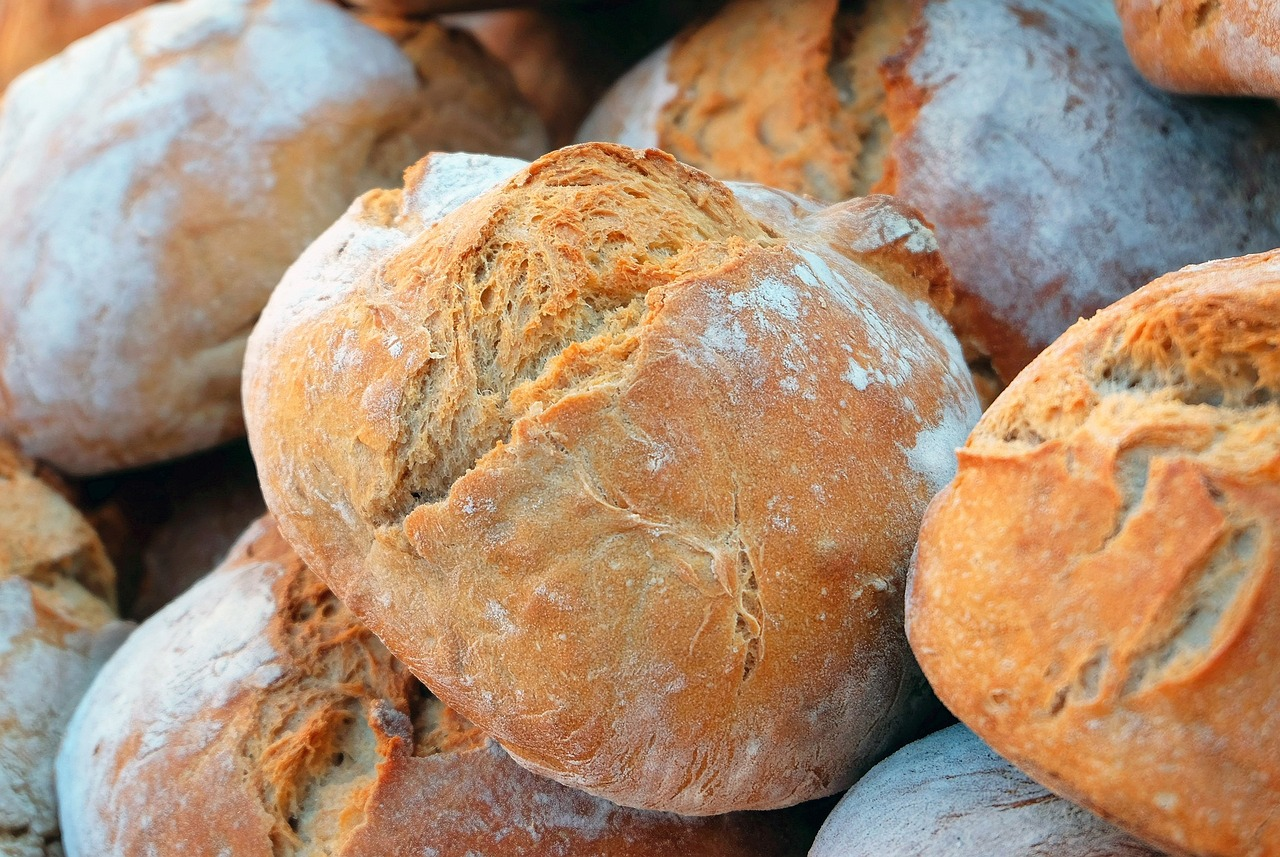
We see the richness of John’s imaginative insight today. Jesus said, “I am the bread of life. Whoever comes to me will never be hungry, and whoever believes in me will never be thirsty.” Jesus identifies himself with bread, and that symbol of bread immediately carries us back to so many other stories in the texts, doesn’t it? Multiplying loaves on a hillside; Matthew’s reference to us not living by bread alone; as well as references to the Hebrew texts such as in today’s reading about Elijah. Elijah had given up hope with Jezebel on his heels, and God provided and prompted the angel to show him the cake and water and tell him “Get up and eat.” Pay attention to what is provided for you to sustain you.
Bread is ubiquitous in the Biblical texts, because it was–and is–a core staple of life. It is a foundational food that we humans developed early on, and it has sustained us for millenia. So when Jesus says “I am the bread of life,” when he identifies himself metaphorically with this core sustenance, we pay attention.
Taste and see that the Lord is good.
The tension comes when the Jewish religious establishment–and remember this is what John means when he writes “The Jews”–questions such a proximate association with the divinity. Theirs was a different school that emphasized the separation between the creator and the creation, and here was Jesus teaching that the Kingdom of God was at hand, that the presence of God was incarnate, and that, somehow, the best way to understand him was apparently bread.
When they question him, he just goes for it, we could say, and responds:
I am the bread of life. Your ancestors ate the manna in the wilderness, and they died. This is the bread that comes down from heaven, so that one may eat of it and not die. I am the living bread that came down from heaven. Whoever eats of this bread will live forever; and the bread that I will give for the life of the world is my flesh.”
Interestingly, this word “flesh” used there is very intentional. In other places in the Biblical texts, the Greek word soma is used, which is a much broader and–shall we say–more palatable word for body. But John intentionally uses the word sarx which explicitly means flesh. John really wants to make a point about the embodiment of the divinity here!
We may read these texts and imagine ourselves there hearing this, and we may think that everyone there would have thought Jesus absolutely crazy. What must they have thought when they heard him say “the bread that I will give for the life of the world is my flesh?”
Actually, the spiritual climate at that time would have experienced a curious dynamic with linking divinity with flesh. The ancient Dionysian cults actually incorporated moments of ecstasy, being taken out of one’s normal way of thinking and behaving, where they consumed raw flesh. Theirs could be a brutal practice. Many others had various interpretations of taking the divinity into oneself, of consuming the divinity in order to share in it. Their symbolic life enabled them to imagine what it would be like for a human being to share in the divine life, as it were.
So, we are always curious as to just what the people who heard these images would have actually felt–in their bodies, as it were. There is no doubt that the Jewish religious establishment found this abhorrent, but John is pushing the point here around just how far we are willing to imagine–to share in–the Incarnation of God in the person of Jesus Christ.
Taste and see that the Lord is good.
Of course, this moment in John 6 makes us think of the Last Supper, doesn’t it? All the Gospels and St. Paul in I Corinthians focus our attention on the moment when Jesus tells his disciples–and us– This is my body, broken for you. This is my blood, shed for you. Eat this in remembrance of me.
This Eucharistic presence is the heart of our life here, the absolute heart of our life. All else that we do, every single part of our life at the church from building work to music to pastoral care to paying bills to outreach, is rooted in our participation in this reality, in the sharing of Christ’s Body and Blood. As well, we are challenged to see every aspect of our personal lives as rooted in this Eucharistic identity.
So, how might we hear this saying differently now: We are what we eat? St. Augustine, in late 4th and early 5th century Northern Africa, took this spiritual insight and formed the prayer we now use during our Eucharistic celebrations: Behold who you are; may we become what we receive.
What we take into ourselves transforms us and is woven into the fabric of our being. So, we are always challenged to ask ourselves “What are we taking into ourselves?” The BBC had an article this week that said the average American–the average American–spends 2.5 hours a day on social media. 2.5 hours a day, out of, say, 16 waking hours. So, one out of eight hours, or 13% of one’s day is spent scrolling and checking social media.
We are what we eat.
Sometimes we do find interesting and helpful information online, and I am grateful for the resources I can explore, but what about the vitriol and hatred and the ceaseless commentators who only want to hook our attention to get their ratings up while advertisers cajole and profits pile up off our attention. What about the stories we read that we know, on one level, are exaggerated at best or completely skewed and outright lies at worst that we still get a thrill at because we want “the other team” to be punched?
What are we taking into ourselves? And why do we pay attention to certain things but not others? How are we hooked into patterns of mindless “doom scrolling” as they say? What are we avoiding in our lives by liking what others had for dinner?
When Jesus told them I am the bread of life, he used the most ordinary and common thing: bread. He didn’t use something complicated. He used something everyone could taste and see and feel. He grounded his presence in a kitchen, in an oven around which life orbited and stories were shared. Yes, there are mountain top experiences, yes we have glimpses of profound beauty that transport our souls, yes we have insights that change the way we see the world. But to understand Jesus, to share his life, to have our life transformed, we come back to the hearth, take our seat at the table, and eat the bread that is given for the life of the world.
Taste and see that the Lord is good.
Behold who we are; may we become what we receive.
We are what we eat.
 Thoughts on a Contemplative Reformation
Leave a comment