
February 4, 2024
Annual Mtng Sunday Sermon
Isaiah 40:21-31; Mark 1:29-39
“Strong winds signify that something is happening”
Have you not known? Have you not heard?
Has it not been told you from the beginning?
Have you not understood from the foundations of the earth?
Last week, Cynthia referenced the psychological evaluations that people have in the discernment process to become clergy. Her story about being asked if strong winds scare her made me laugh–and think. She made this comment, which has stuck with me all week: “strong winds signify that something is happening.”
In terms of my own profile, being an empath, one of the key parts of my experience in my family system is that I became very good at feeling when there is tension in a room. I can feel it in my body like a pressure on my chest, and my breathing becomes more shallow. As a child, I learned coping mechanisms (and remember that our super powers can often be our key struggle points). I learned how humor can deflate the intensity or at least deflect it. I learned how to play coy to avoid an outright conflict or at least delay it until I felt more secure. To use the image of strong winds, my coping skills helped me lower the sails when I needed to or turn myself to remain more stable when the storms arose.
We live in a time of strong winds, with storms raging around us. It seems that, politically, any goal of truly supporting the common good has been replaced by a cynical climate that seeks only the destruction of “the other” in the cold pursuit of power. In social terms, we feel more divided than ever, and our obsession with social media, instant news and other distractions only exacerbates our feelings of loneliness and separation.
That great image from W. B. Yeats’ poem “The Second Coming” resonates with what I experience:
Turning and turning in the widening gyre
The falcon cannot hear the falconer;
Things fall apart; the centre cannot hold;
Mere anarchy is loosed upon the world,
The blood-dimmed tide is loosed, and everywhere
The ceremony of innocence is drowned;
The best lack all conviction, while the worst
Are full of passionate intensity.
I kept returning to that poem a while back, and when I mentioned it to my analyst, he showed me that it was the introduction to his own doctoral thesis–a synchronicity properly befitting a Jungian, I think.
We feel this way, don’t we: the storm raging, the center threatening to crumble, while we struggle to discern how to remain present in the midst of the turmoil–or whether to remain present at all. As we say so often, in times of such pressure, there is always the temptation to check out, act out, or numb out. And perhaps we could add another option given the climate we are in: the choice to lash out–and don’t we have so much of this now with so-called leaders? To use Yeats’ image, we see in some a “passionate intensity” utterly devoid of moral grounding that seeks only to lash out at anyone or anything that questions a supposed right to be in control.
Don’t we yearn for something deeper, more authentic in life, a truer leadership that is actually aware of the true needs of society rather than one that only manipulates fears for the pursuit of selfish gain? I love what the former Archbishop of Canterbury Rowan Williams described once, that what some call leadership is actually only saying back what I already believe to be true–but saying it much louder.
It is important to remind ourselves that our times are not unique; they are only our times, so of course they feel pressured and intense because we are living in them right now. That is why I think it is important to study the prophets, and why we are beginning the special Sunday forum next week (which I really encourage you to attend, if you aren’t going to the parenting class or singing in the choir). Now is a time to reflect and pray, my friends.
The prophets in the Hebrew texts dared to listen and remain present in the midst of the turmoil and storms of their lives. They lived during times of enormous social upheaval and religious conflict, and they paid close attention to the presence of God while seemingly impervious empires crumbled.
We are by no means the only empire who has felt as though they would last forever, and we wonder what our idolatry and worship of ourselves has led to. When it comes to the absolute grounding of the Gospel’s call, can we honestly say how we are misaligned with God’s intent? Do we have the spiritual courage to wonder how we should realign our lives in order to experience wholeness?
The prophet Isaiah, in today’s texts, offers us a particularly intense hope in the face of enormous challenge. It is not a sentimental hope, and there is nothing shallow about it. It is grounded in this central question: in the face of turmoil and stress, what is truly real, and how are we called to place our hope in the reality of God’s presence rather than in the shallow and illusory claims of the culture–or in the shouting of supposed leaders who claim a right to rule? It turns out that the prophets are always prescient for the circumstances at hand.
Have you not known? Have you not heard?
Has it not been told you from the beginning?
Have you not understood from the foundations of the earth?
It is he who sits above the circle of the earth,
and its inhabitants are like grasshoppers;
who stretches out the heavens like a curtain,
and spreads them like a tent to live in;
who brings princes to naught,
and makes the rulers of the earth as nothing….
To whom then will you compare me,
or who is my equal? says the Holy One.
Lift up your eyes on high and see:…
The Lord is the everlasting God,
the Creator of the ends of the earth.
He does not faint or grow weary;
his understanding is unsearchable.
He gives power to the faint,
and strengthens the powerless.
Even youths will faint and be weary,
and the young will fall exhausted;
but those who wait for the Lord shall renew their strength,
they shall mount up with wings like eagles,
they shall run and not be weary,
they shall walk and not faint.
The prophets are bold and persistent in reminding us that when it comes to our practice of faith, we must make a choice of what we are going to listen to and who we are going to follow. The prophets also remind us–and Jesus takes up this prophetic message in his own life and teaching–that a core aspect of having an authentic practice of faith is recognizing that we are called to make a sacrifice. Something must be given up in our attachment to the culture’s values, in order that we can be aligned with God’s will. Put another way, as we hear described in the Gospels of Luke and Matthew, we cannot serve God and mammon, with mammon symbolizing this blind attachment to riches or worldly values. “No one can serve two masters,” Jesus says. “For where your treasure is, there your heart will be also.”
“Strong winds signify that something is happening.”
Have you not known? Have you not heard?
Has it not been told you from the beginning?
Have you not understood from the foundations of the earth?
In terms of my own tendency to feel where tension is in the room, I need to say this at this point, given where we are: when it comes to what we are experiencing now as a nation and a wider world, I will not poke you in the eye, but I will also not relieve you of the tension you feel right now as this storm rages, because I truly believe that the Spirit is in this storm and is inviting us all to pay attention and decide, yet again, if we will cling to the dynamic presence of the living God.
When Jesus first sent the disciples out in pairs, he did it because he knew the challenges they would face, and he knew that they would need to hold one another accountable. He knew they would need to support each other in times of confusion and in times of raging storms.
In terms of the wider life of the Christian community, we face an enormous challenge today. We are being called to learn, yet again, how to discern within discomfort, how to make a conscious choice grounded in the living presence of God within a time of social stress. How can we listen with our hearts and seek necessary conversion and not, as it were, check out, numb out, act out, or lash out?
Isaiah and the other prophets faced their circumstances sure-footed in the awareness that God’s presence was the most real thing in their lives, and they made a choice not to blindly follow the values of social pressures or political institutions. That legacy of prophetic embodiment continues throughout our time, and we can point to key saints and sages who made the choice for themselves in their own day–and we see how their sacrifice sometimes cost them.
The Church today is called to embody this prophetic imagination. “Church” is not a place where we come only to receive some sort of religious service that meets our expectations in music we like, hymns paced at the right speed, flowers and vestments we find beautiful, food we find lovely, or even in wine that tastes good (although I will say that we don’t want awful wine). No, Church does not exist only on the level of a temple function where we come and receive what professional temple priests can do for us. No, Church is what we are willing to make it, partnering with the Spirit, because we are the Church. We are the Body of Christ in the world today, taking our place in a long line of prophets, priests, people, families, saints and sinners who have looked to Jesus as the embodiment of our hope.
Interestingly, when it comes to the beauty of the design of the building, a deeper truth is always hidden right in front of our eyes. It is true that “strong winds signify that something is happening.” And it is true that we are living in strong winds today that seek to knock us off course and convince us that we should place our hope in the vainglory of a few human beings who crave power.
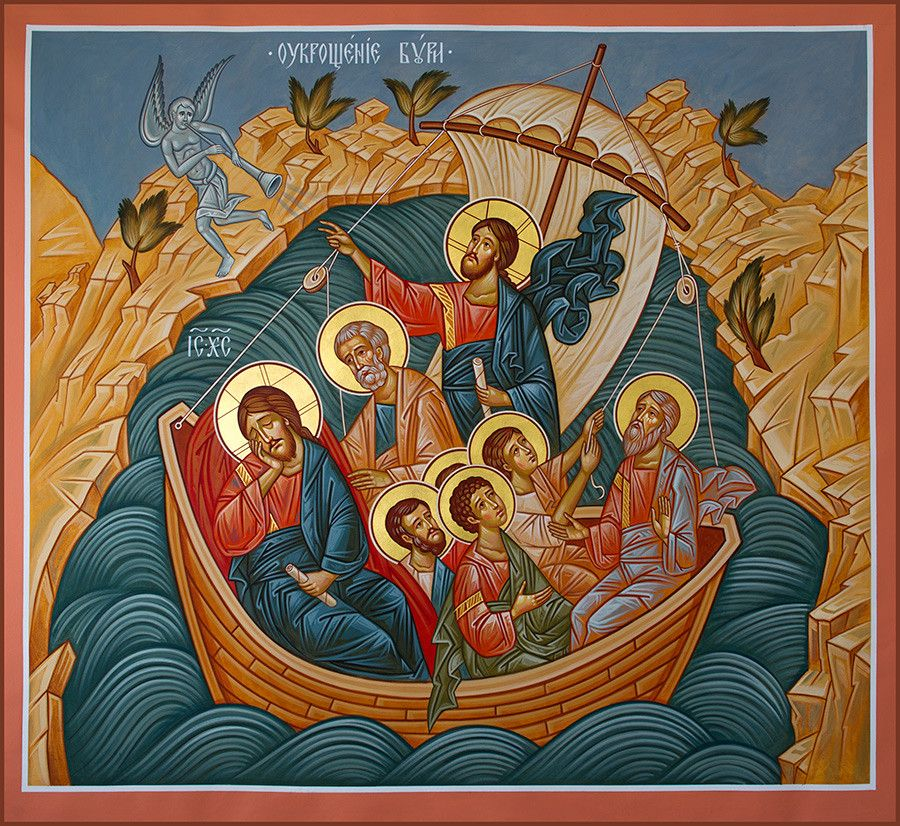
But I know two things to be true: first, we worship the one who calms storms, and we are wary of those who blithely stir them up only to benefit themselves.
And, two, I celebrate the beauty of how this space is called a nave, signifying a ship. When we gather in this space, we remember that we are traveling together, and although we may pretend otherwise and may think we can bomb each other into oblivion, we are all in the same boat at the end of the day. We need each other, to hold one another accountable and encourage each other in difficult times. And, when the storms rage, may we have the courage to listen deeply and turn to our neighbor and say,
Have you not known? Have you not heard?
Has it not been told you from the beginning?
Have you not understood from the foundations of the earth?
but those who wait for the Lord shall renew their strength,
they shall mount up with wings like eagles, they shall run and not be weary,
they shall walk and not faint.
 Thoughts on a Contemplative Reformation
Leave a comment