
The Rev. Dr. Stuart Higginbotham
Sermon for July 16, 2023
Seventh Sunday after Easter
Matthew 13:1-9, 18-23
Seeds all over the place
I love gardens. When we were back in Arkansas visiting family, I had the chance to go into my grandparents’ backyard and pick squash, peppers, and cucumbers from a garden that my Aunt Tonya had set up with my mother. There were so many squash and peppers (my favorite) and we brought home a big bag of each to cook over the next week. I like feeling the earth and picking what I eat, smelling the leaves and seeing the squash blossoms spread all around.
I have a small herb and flower garden in our backyard at home, and it always makes me feel settled, grounded (literally) to be able to spend even a little time each day outside weeding or cutting herbs or lying in the hammock under the trees reading a book. These days we are keeping an eye out for the goldfinches who will soon come to eat the purple coneflower seeds.
I have so many memories of gardens as a child, at both sets of my grandparents’ houses. At my Meme and Daddar’s, I loved how Daddar had more of a scattered approach with his garden. Things were just grouped together higgledy piggledy, if you will, onions tucked over by the black berry bramble. They had this incredible dachshund named Muffie, who I believe was one of the smartest dogs ever. During the hot Summer days, Muffie would go out into the garden, pick a cucumber, carry it back to the carport, lie on her stomach on the cool concrete and eat it. Honestly, that was one smart dog.
We humans are connected to the earth. We are part of the earth, so we can understand why Jesus spent so much time telling parables that draw upon the details of agricultural life. Our lives have gotten more and more removed from the grounding in the earth that is our true nature, so sometimes when we read so many stories about sheep and goats and vineyards and, with today’s Gospel, sowing seeds, it can seem distant to some folks. And that makes me sad–and concerned, given the challenges we all face with the climate changing so much. It seems the more and more we feel removed from the earth, it becomes easier and easier to see it as just a commodity we can use–and this is to our own peril.
Look back at some of the images from the Psalm this morning, and notice how these words and images actually make you feel. Can you feel these words in your body, in your soul?
9 You visit the earth and water it abundantly;
you make it very plenteous; *
the river of God is full of water.
10 You prepare the grain, *
for so you provide for the earth.
11 You drench the furrows and smooth out the ridges; *
with heavy rain you soften the ground and bless its increase.
12 You crown the year with your goodness, *
and your paths overflow with plenty.
13 May the fields of the wilderness be rich for grazing, *
and the hills be clothed with joy.
14 May the meadows cover themselves with flocks,
and the valleys cloak themselves with grain; *
let them shout for joy and sing.
I believe we know, on a deep level in our souls, that we are connected to the earth in such a powerful way, and we can feel the resonance, if you will, when we take time to reflect on the fullness of life that we experience.
Today’s Gospel reading gives us an opportunity to spend a bit of time focusing on the dynamic of sowing seed and nurturing a crop–of course, with this being a metaphor for what it means to have a faithful and whole human life.
The text opens with Jesus teaching a large group of people, and there are so many that he gets into a boat to get a bit farther out from the shore to get a wider perspective. He tells them a parable about a sower scattering seed, with four different scenarios of how that planting plays out.
The first is the seed that is scattered on the bare ground where birds come and eat it.
The second is the seed that lands on rocky ground with just a bit of dirt. The plants sprout quickly, he says, but since there is no depth of soil, they wither and die.
The third is the seed that is sown and takes root on land that also has thorns. The thorns grow around the plants, choking them.
And the fourth is the seed that lands on good soil, which takes root and grows, producing a large amount.
So, four scenarios, if you will, that he then takes and actually interprets for the people. He says that the first is, of course, seed that is just bare and exposed to “the evil one,” who comes and snatches it away. The second is seed that is received so quickly, even with joy, but since there is no depth of root, it isn’t sustainable. The third is seed that sown among thorns is seed that is choked about by the other distractions and concerns of the world that compete with a spiritual grounding in life. This is what we hear in the reading from the Letter to the Romans this morning: For those who live according to the flesh set their minds on the things of the flesh, but those who live according to the Spirit set their minds on the things of the Spirit. And the fourth, of course, focuses on the necessity of good soil that is tended and prepared, so that there is an abundance of life.
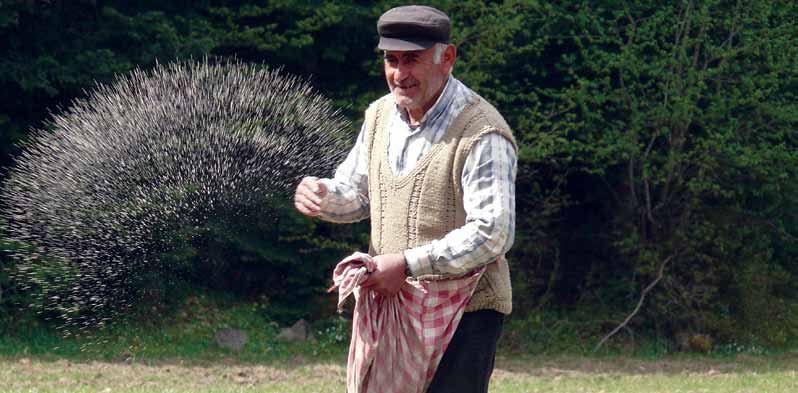
We can learn a lot about ourselves and who we understand God to be when we reflect on this text. On Wednesday, when we looked at the story, Stan Lewis said something very important about how the text actually shows us that God is an extravagant sower. God doesn’t discriminate where God throws the seed. Seed gets thrown everywhere. So, potential is everywhere; possibility and hope are scattered around with God’s abundance. God doesn’t calculate some sort of risk assessment like we might before God reaches into the bag and throws out potential all over the place. Now, that tells us something very profound about God, I think.
The story also tells us something profound about ourselves, namely, that the heart of our spiritual work is to focus on our own receptivity and participation with God’s abundance. This shifts things a bit from how we may have been taught–and how our culture emphasizes things. Rather than thinking we have to do something to deserve the grace that flows out abundantly, we find that our spiritual work is actually focused on our own lives and how our spiritual hearts (the soil in the story) is tended and cared for and prepared to receive the abundance that God so freely pours out. It isn’t a matter of deserving; it is a matter of receiving.
The story also tells us something important about the dynamic of spiritual practice, namely, that there is work involved. Our spiritual lives are not meant to be passive. Without us tending the soil of our spiritual heart, the seed will land on bare rock only to be eaten up immediately, or will land on thin soil, shoot up quickly, but wither away, or land on soil and be choked out by our preoccupations with dynamics in the world.
We have work to do. We do not earn grace, but we are called to nurture our spiritual hearts in such a way that our receptivity and participation is increased. This is vitally important to understand why it is important to practice our faith. We put energy into the dynamic.
It’s like the old description you may have heard, where the person said “just sitting in a service doesn’t make you a Christian any more than sitting in a garage makes you a car.” Rather, we are called to practice our faith, to pay attention to how we can nurture the gifts and strengths that the Spirit has given us, so that we live more faithfully in the world. So, to put a fine point on it, come to Sunday School not to sit in a class but to explore the dynamics within your own heart. Bring your children, not that you are earning grace or somehow trying to make sure nothing bad will ever happen to them, but that you need to prepare them so that when they struggle the good soil you have nurtured can weather the storms they experience. Learn about how you can share your gifts in supporting the broader community as we wrestle with dynamics around race, injustice, poverty, social pressure, greed, and the ongoing questions we are called to ask about what a faithful and loving community looks like. Practice doesn’t make perfect, it makes us more faithful people, I think.
Make no mistake about it, God is going to keep throwing seed all over the place. She is quirky like that, just reaching in the bag and throwing potential and gifts all around. Some may think this is wasteful, but God goes by a different economy than we do. And what we learn from the reading from Isaiah is that the potential will take root somewhere. It will grow, and it will bear fruit, because God wills it.
so shall my word be that goes out from my mouth;
it shall not return to me empty,
but it shall accomplish that which I purpose,
and succeed in the thing for which I sent it.
It seems to me that the question before us is this: do we want to participate in the fullness of life that God dreams for this world? Or to come at this another way, how can we avoid being the thorns in someone else’s life, even?
What do we need to do to break open the dry, caked ground of our spiritual heart, to water it, tend it, put fertilize on it, so that it can welcome the seed that God tosses out and bear fruit that can make the world a better place?
 Thoughts on a Contemplative Reformation
Leave a comment